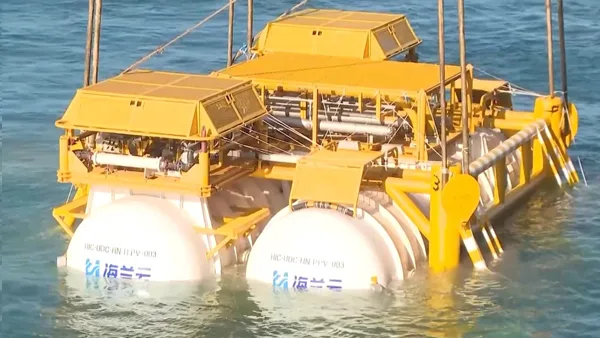
Off the coast of Shanghai, an ambitious technological experiment is taking shape beneath the ocean surface, the world’s first commercial-scale, wind-powered underwater data centre (UDC). The innovative project aims to address one of the biggest challenges facing the digital age: the enormous power and cooling demands of modern data center.
Traditional land-based data centers consume vast amounts of electricity and freshwater to keep their servers from overheating, with cooling systems often accounting for nearly half of total energy use. In contrast, the new underwater facility uses the natural cooling power of the ocean to regulate temperature. Servers are housed in pressure-resistant steel pods, which transfer heat into surrounding seawater through external heat exchangers. This method reduces cooling energy consumption to less than 10% of total power use, cutting overall energy needs by about 22.8% and eliminating freshwater use entirely — a major advantage in regions facing water shortages.
Located near the Lin-Gang Special Area of the China Pilot Free Trade Zone, the facility is almost entirely powered by offshore wind energy, sourcing over 95% of its electricity from nearby wind farms. This combination of renewable energy and subsea cooling allows the data centre to achieve an exceptionally low Power Usage Effectiveness (PUE) rating, making it significantly more efficient than most traditional data facilities.
The project, costing approximately US$226 million, is designed to handle high-performance computing workloads, artificial intelligence applications, and 5G network infrastructure. Despite its massive computing capacity, the structure occupies 90% less space than a similar land-based data centre, highlighting its compact and sustainable design.
However, experts have raised concerns about the potential environmental effects of large-scale underwater computing. The warm water discharged from these systems could contribute to thermal pollution, potentially disturbing nearby marine ecosystems. Engineers have implemented corrosion-resistant coatings with glass flakes to protect the steel pods from saltwater damage, but environmental scientists continue to call for further research to assess long-term impacts.
While initial studies suggest only minor temperature changes in surrounding waters, marine specialists caution that large-scale adoption of such technology could still pose risks to delicate ocean habitats.
If successful, this groundbreaking approach could redefine how the world builds and powers its digital infrastructure which offers a cleaner, cooler, and more efficient future for global data storage and processing.