While oceans cover over 70% of the Earth’s surface, much of the deep-sea floor remains unmapped and mysterious more obscure than even the moon’s surface. The reason? Harsh conditions, limited access, and outdated surveying methods have long hindered exploration. However, this is beginning to change thanks to advanced underwater robotics.
U.S.-based tech startup Bedrock Ocean is making waves in this space with a recent $25 million Series A-2 funding round, aimed at revolutionizing how we understand and map the ocean floor. Investors in the round include Primary, Northzone, Autopilot, Costanoa Ventures, Harmony Partners, Katapult, and Mana Ventures.
A Shift from Traditional Ships to Smart Submersibles
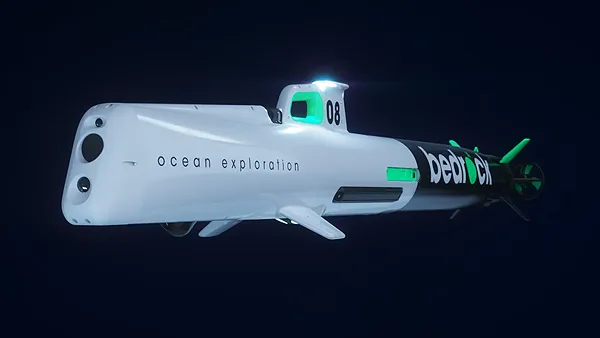
Unlike conventional ocean-mapping efforts that rely on large, fuel-hungry ships and human crews, Bedrock’s innovation lies in autonomous underwater vehicles (AUVs). These battery-powered subs can operate independently for up to 12 hours, using sonar and magnetic sensors to map the seafloor with impressive efficiency.
While the AUVs still need to be deployed from ships, they drastically reduce operational costs and ecological impact. In fact, just two AUVs can cover as much ground as one traditional mapping vessel, and a single 40-foot ship could potentially carry 10–12 AUVs—making ocean surveys faster, cheaper, and less disruptive to marine life.
Environmentally Safer and Technologically Advanced
Bedrock’s sonar technology operates at a frequency outside the hearing range of marine mammals, minimizing harm to aquatic ecosystems—something that’s become increasingly important for environmentally sensitive industries like offshore wind energy and marine conservation.
The vehicles cruise just 5 to 10 meters above the seabed, using onboard sensors to collect and partially process data. When ready to transmit, the AUVs surface and send the data to their support vessel via Wi-Fi. A Starlink satellite connection then beams this data to the cloud for real-time analysis, enabling teams to make informed decisions faster.
Mapping at Scale, Not Just with Precision
While ship-based surveys can offer sub-meter accuracy, Bedrock’s AUVs provide positioning accuracy within 1–2 meters due to limitations in GPS under the sea. However, for many commercial and environmental projects, speed and efficiency outweigh the need for extreme precision. For instance, offshore wind developers may need high-accuracy mapping during the planning phase, but faster, slightly less precise data may be sufficient during installation and maintenance.
Commercial Potential in India
For a nation like India, with a vast coastline and growing investment in offshore wind farms, oil exploration, and blue economy projects, such underwater mapping technology presents immense opportunities. Faster, cost-effective seafloor surveys could significantly reduce project timelines for India’s renewable energy ambitions and maritime initiatives.
Catching the Attention of the U.S. Navy
Bedrock has already completed paid surveys for sectors like wind energy, oil and gas, and environmental assessments. Notably, the startup’s real-time data capabilities have also drawn the interest of the U.S. Navy, which reportedly praised the system’s speed and data quality during demonstrations.
For India
With the government pushing the boundaries of the Deep Ocean Mission and sustainable marine exploration, companies like Bedrock Ocean are paving the way for global collaborations and technology transfer that could greatly benefit India’s coastal and underwater infrastructure development.