


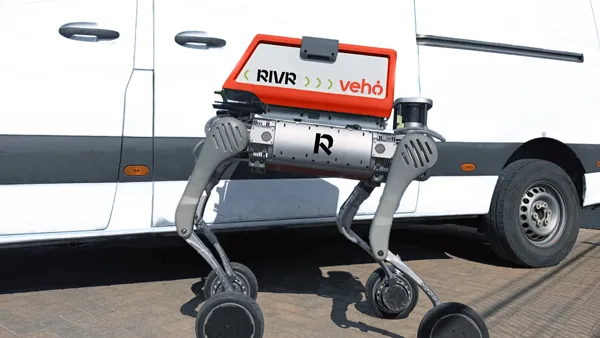
While most delivery automation solutions stop at the curb, a new collaboration between logistics company Veho and Swiss robotics startup Rivr is aiming to bridge the gap between the delivery van and the customer’s doorstep — often referred to as the final 100 yards of delivery.
In a recently launched pilot in Austin, Texas, Rivr has introduced a compact, four-wheeled robot capable of climbing stairs and navigating complex paths. The robot, which its inventor humorously compares to “a dog on roller skates,” is designed to transport packages directly from Veho’s delivery vans to people’s doorsteps.
The pilot is starting on a small scale with just one robot operating under close supervision. This robot will carry out deliveries for five to six hours a day across various Austin neighborhoods. However, both companies believe this small step is key to addressing a highly specific challenge in automated logistics: the last few metres of delivery, which are simple for humans but often very complex for machines.
Rivr’s technology aims to be a game-changer in this space. Unlike many existing delivery robots that only operate on sidewalks, Rivr’s bots are designed to move through stairs, pathways, and doorways. This, the company believes, is the next natural evolution in delivery robotics.
The trial will also help Rivr gather real-world data, which is crucial for improving robotic intelligence. While large language models like chatbots learn from vast online datasets and autonomous vehicles collect data from thousands of road tests, the robotics sector lacks such a wealth of practical information. Rivr hopes this project will begin filling that gap, helping its robots become smarter over time.
For Veho, which serves over 50 cities across the US and partners with well-known brands like HelloFresh and Sephora, the experiment represents an opportunity to explore how automation can improve delivery efficiency. In the long run, this could lead to robots and drivers working together on the same street, enabling more packages to be delivered in less time — especially in busy urban settings.
The robots are also expected to ease the workload for delivery staff by taking over the most physically demanding part of the job — walking door to door. During the initial phase, a Rivr team member will accompany the robot to ensure safety and smooth functioning. While the bots can operate independently, they can also be controlled remotely if they face unexpected obstacles.
The trial is starting in the quieter Northwest Austin area and is likely to expand into more densely populated parts of the city. Veho is also considering adding vehicle-mounted charging stations to keep the bots running throughout the day.
Looking ahead, Rivr aims to scale up to 100 robots by next year and eventually reach thousands by 2027. The company has already begun operations in the UK through a partnership with another delivery platform and has raised over \$25 million in funding, with backing from several prominent investors.
This innovation could inspire similar robotic solutions in Indian cities, where dense populations, diverse terrain, and growing e-commerce demand make efficient last-mile delivery increasingly essential.

